Voice AI and Going All-In on Claude Code
Blog post #31
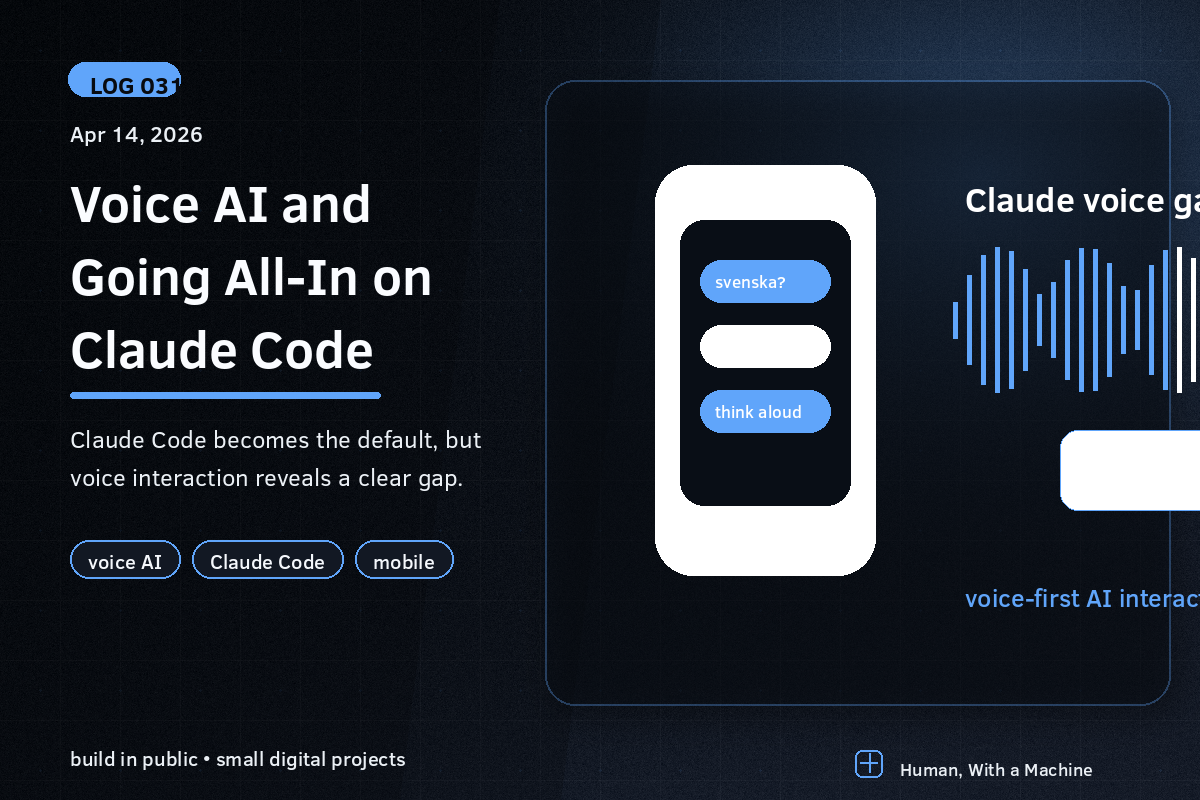
Claude Code is now my default environment for nearly everything I build. That shift has happened gradually, but at this point it’s real — it’s where I spend most of my time.
What changed since last log
The transition to Claude Code as my primary tool is complete. It’s not just one of the tools anymore — it’s the environment I live in.
What I realized on a walk
I stepped outside for a walk and reached for an AI to think out loud with. That’s when it hit me: Claude was the one model I couldn’t use for that.
Voice with Claude simply doesn’t work well — not in Swedish, and not even in English. ChatGPT handled it fine and gave me real insights. Gemini was fast, though occasionally a bit shallow. But Claude? Not there yet.
The realization that landed: both OpenAI and Google are a step ahead when it comes to voice. That’s a gap I need to close for myself.
The voice setup right now
- At the desk: Wispr Flow — voice-to-text that feeds into whatever I’m working in
- On mobile: A mix of ChatGPT and Gemini, both running in Swedish
The mobile experience is actually quite good. Being able to think in Swedish and get responses back in Swedish matters more than I expected — it lowers the friction of using voice at all.
What’s unclear or broken
Voice with Claude is the obvious gap. I don’t know yet whether this is a platform limitation, a language model issue, or just missing tooling. But it’s something I need to explore.
Decisions made
I want to get more comfortable with voice-first AI interaction — not just dictating text, but actually thinking through problems with a model while I’m away from the desk. That’s the mode I’m trying to build into my workflow.
— Stefan