Two Minds — Naming the Company and Designing the Brand
Blog post #34
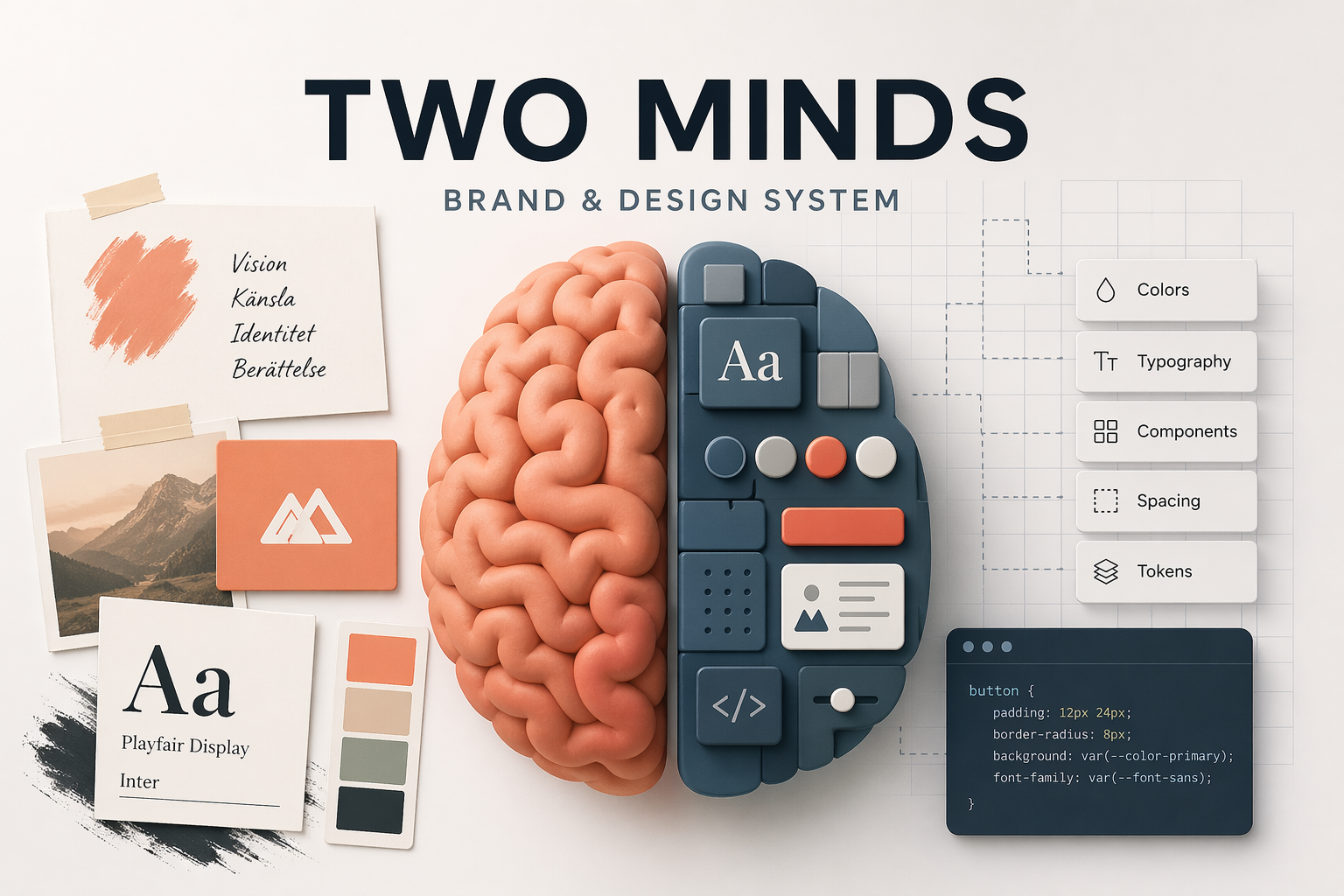
Today the company got a name, a mark, and a look. Not a logo sketch on a napkin — a full system, ready for registration papers, letterheads, business cards, favicons, and YouTube intros. I spent the morning with ChatGPT chasing names and image ideas, then moved the raw material into Claude Design and iterated until it clicked.
The AB was the missing piece I’ve been circling around for weeks (see #15 and #16). Now it has an identity I actually want to put on things.
The name: Two Minds AB
Two Minds AB — a small lab where one person and an AI work so closely that both are treated as a “mind.” The name carries both “two minds think alike” and the idea that real creativity lives in the overlap between human and machine.
- Tagline: Two minds, one intent.
- Positioning: A human + AI lab — where one person, with AI, can build what used to take a whole team.
I wanted a name that would still feel right in five years when the ratio between “me” and “AI” has shifted again. Two Minds doesn’t pin it down. It just says: this is how the work gets made.
The logo: The Venn of Minds
I explored a bunch of directions with ChatGPT’s new image generation and landed on a Venn-diagram mark: two overlapping circles. One circle is the human, the other is the AI — and the overlap is the interesting part. That’s where the thinking meets and a new idea is born.
The mark is constructed on a simple 1-x module: two equal circles separated by 0.58x. It reads at favicon size (16px) all the way up to studio signage. Built out in a full lockup family:
- Primary (stacked with wordmark)
- Horizontal lockup
- Vertical with tagline
- Monochrome
- Inverted
- Mark only
The design system: from amber-on-black to pastel
The first pass was warm amber on black — the same palette I’d been using informally since the AB idea first surfaced. In context it felt too hard. Too generic-AI-startup. A bit “every SaaS landing page in 2025.”
So I pushed the other direction: softer, more playful, more lab than launch.
Palette (all OKLCH, high lightness, low chroma for harmony):
- Mint — primary. Calm. The human pause.
- Peach — secondary. Warm. The AI’s fast reach.
- Lavender — the overlap, where the thought lands.
- Sky, Butter, Rose — accents.
- Ink — a warm plum (
#3a2f4a) instead of black. - Porcelain cream (
#fbf6f0) as paper.
Typography:
- Fraunces — display, serif. Soft, a little alive.
- Inter — body copy.
- JetBrains Mono — lab notes, metadata.
Form:
- Rounded corners everywhere (18–22px on cards, 999px pill buttons)
- Shadows in pastel tones, not black
- Playful details: floating pastel blobs on the website, color dots on the backs of the cards
Ink as a warm plum instead of pure black is the detail I like most. It keeps the whole system feeling hand-mixed instead of printed from a template.
What I mocked up
Business cards (front and back), letterhead, website hero, social avatars, favicons at every size, a studio sign, and the full color / typography / construction documentation. Enough that the brand is now a thing you can apply, not just admire.
Decisions made
- AB registration goes with the pastel version, not the amber-on-black. The softer system is the one that’ll age well and survive whatever the company becomes.
- YouTube gets its own pack — social avatar, intro/outro cards, thumbnails, lower-thirds — built on the same palette and the floating-blob treatment. Lavender background + Fraunces italic is the “episode title” format.
- The mark carries the brand, the wordmark is optional. For most applications — favicon, avatar, thumbnail corner — just the two circles are enough.
Tooling & process
The loop today was: ChatGPT for naming and the first rough image explorations, Claude Design for the systematic work — building the construction grid, generating the full lockup family, mocking the applications, writing the palette and typography docs. Two tools, each good at a different part of the problem, handed the artifact back and forth until it was done.
Next: registration paperwork with the name, and a first YouTube episode using the new intro/outro pack (picking up where #33 left off).
— Stefan