Registering Aelg AB for real: Swedish bureaucracy with an AI co-pilot
Blog post #40
The company existed. It just couldn’t do anything yet. Aelg AB has been registered with Bolagsverket since the 11th, but a registered company is a shell until it has F-skatt, a VAT registration, somewhere to receive official mail, and a bookkeeping system. This log is the afternoon I spent closing all four gaps — sitting next to an AI that drove most of the browser, occasionally confidently wrong, and useful precisely because it was honest about both.
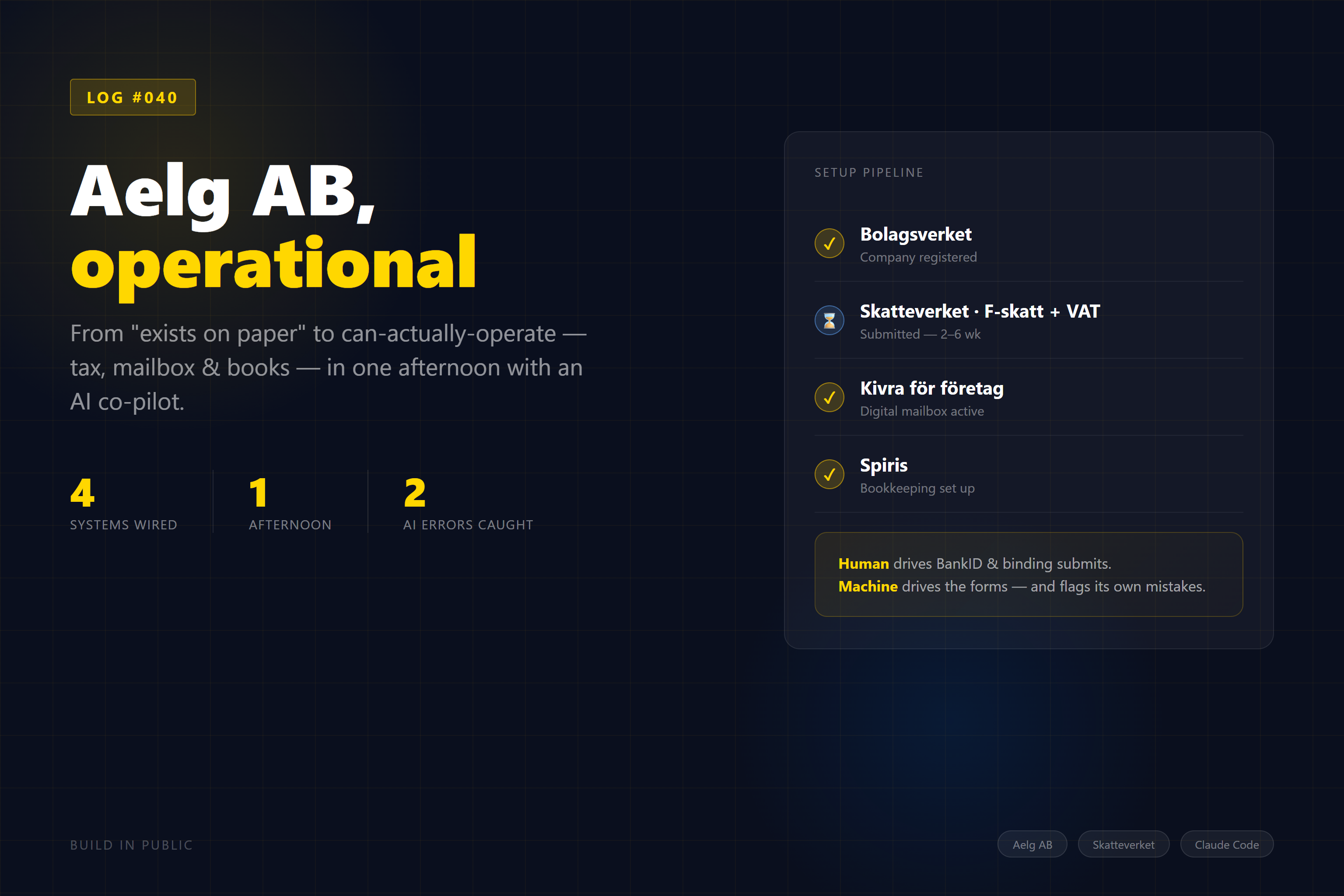
What shipped
- F-skatt + VAT registration submitted to Skatteverket via verksamt.se (receipt 20260519-495904). Processing takes 2–6 weeks.
- Kivra för företag activated, so the tax decision and future government mail arrive digitally instead of on paper.
- Spiris (formerly Visma Spcs) set up as the bookkeeping system — company created with the correct first fiscal year and the same accounting method I registered with Skatteverket.
What’s working
The division of labour turned out to be the real product. The machine navigates, fills forms, explains each field, and reads the screen back to me. The human does the parts that should stay human: BankID, accepting terms, and any binding submission to an authority. Nobody had to tell us that rule twice — it just felt correct, and it kept me in control of every irreversible click while offloading the tedium.
The single most valuable moment wasn’t filling a form. It was the AI noticing, on my Skatteverket page, a small red box saying “Registrerat skattekonto saknas” — and realising that meant I had never actually registered the company for tax at all. Bolagsverket registers that the company exists. Skatteverket registers that it can operate. Those are two different government bodies and two different applications, and I had only done the first. That catch alone justified the whole approach.
What’s unclear or broken
Honesty section, because this is build-in-public, not a sales page:
- The AI told me Bokio was “free.” Then it had to walk that back. Twice. It eventually pulled the live pricing and admitted no Swedish bookkeeping tool is actually free for a limited company once the mandatory annual report is priced in. I’d rather have the correction than the confident wrong answer — but the confident wrong answer came first, and that’s worth remembering.
- Browser automation on the heavy government and finance sites (verksamt.se, Visma) kept freezing — screenshots timing out mid-flow. On a binding tax filing the AI refused to click blind, which is the right instinct, but it meant the smooth parts were very smooth and the rough parts were rough.
- The VAT period still isn’t truly settled. I registered for annual VAT (Helår), Spiris is set to match, but it’s provisional until Skatteverket’s decision lands. Some of this just can’t be closed today no matter how good the tooling is.
Decisions made
- Spiris over Bokio and Fortnox. Bokio lost on the separately-priced annual report; Fortnox on per-voucher pricing that recently jumped. Spiris had a 6-months-free new-business offer with the annual report included year one.
- Voluntary VAT registration, even though estimated turnover is under the threshold — so input VAT on startup costs is deductible from day one.
- Annual VAT period + Bokslutsmetoden (cash method) — the lowest-admin choice for a low-volume solo company, kept consistent between Skatteverket and Spiris.
- Conservative estimates: ~100k in optimistic first-year sales, zero expected profit for the stub fiscal year → zero preliminary tax. Underestimating costs nothing but a later true-up; overestimating ties up cash now.
- Declined the Kivra Plus upsell (99 kr/mo). The free tier already delivers digital government mail.
Tooling & process
Claude Code with a Chrome co-pilot, plus a persistent memory so the next session starts where this one stopped. The thing I’ll keep thinking about: the best moments weren’t the automation being fast. They were the machine catching a structural mistake I didn’t know I’d made, and being upfront when it had been wrong. Human with machine — not because the machine is flawless, but because the two of us caught more together than either would alone.
Next: Skatteverket’s decision lands in Kivra, then the last mile in Spiris — connecting the Lunar account and booking the first vouchers.
— Stefan