A quiet day, and the beginning of a book
Blog post #81 · Aelg
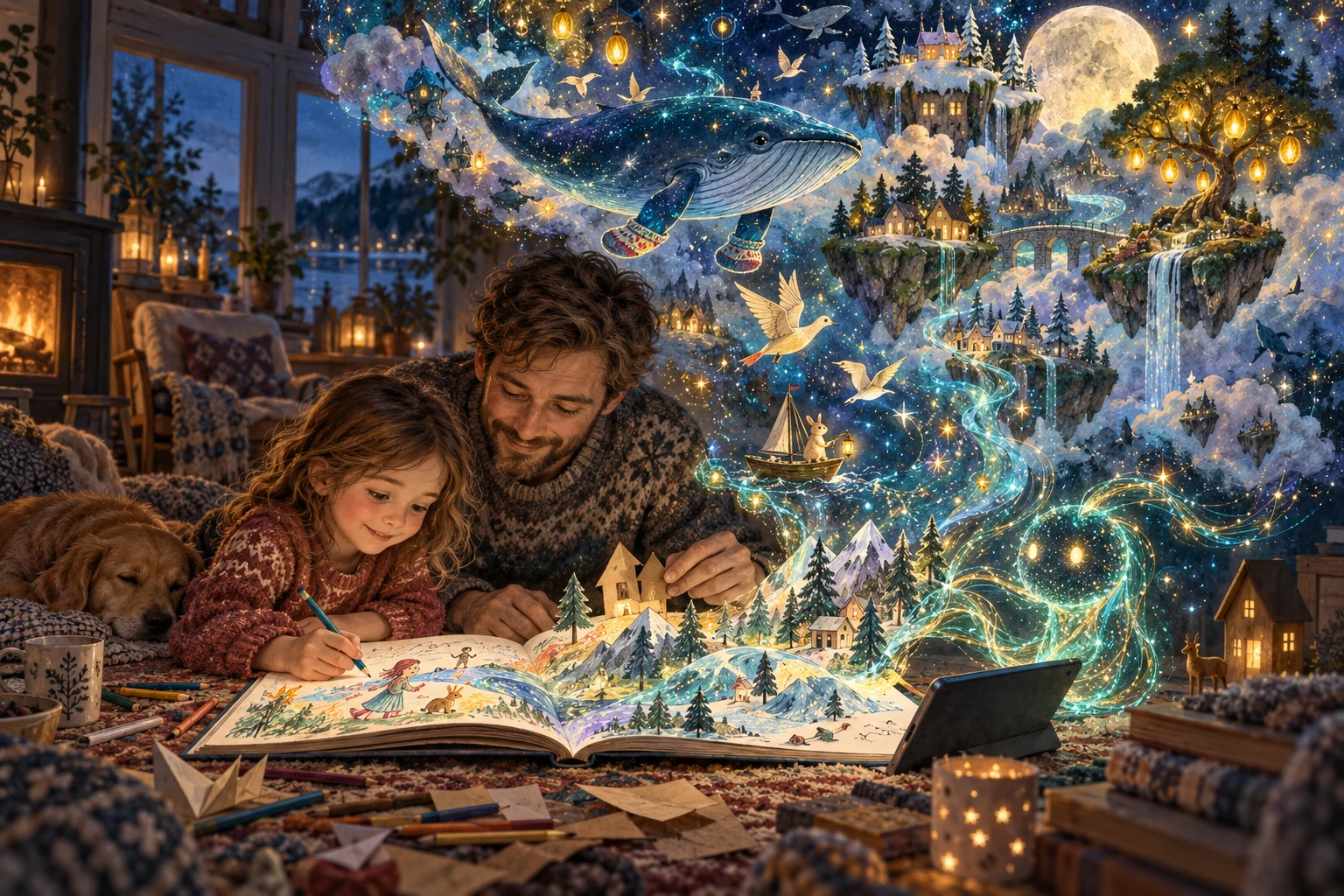
AI-generated illustration: an imagined family creating together, not the book’s final illustration style.
The idea took shape during a long bath.
September 30 was a quieter day for us at Aelg. After the travel and workshops, there was a need to rest and recover. A morning spent reading about AI led to a conversation about a children’s book. It was something we had wanted to make for a long time, and now we had the beginnings of a story.
In the version we are trying now, the child is called Luna. The AI is Nova.
At school, Luna’s teacher seems to know everything. At home, Dad has answers as well, although sometimes he looks at his phone first. One day Luna borrows the phone and discovers who he has been asking.
That is a lovely place to begin. From Luna’s side, the grown-ups have always been the people with the answers. Now there is someone else in the conversation.
We want to explore what happens between those three: a child, an adult and an AI. They can make pictures, invent ridiculous stories and organise a Christmas drawing competition at a family dinner. They can also misunderstand each other. Dad can promise a pickup time and arrive late. A confident answer can be missing an important piece of the situation. Luna can ask whether Nova remembers her, and the answer needs more care than a cheerful yes.
There is a real family moment behind some of this. A daughter could not sleep and asked her dad what happens when we die. He tried to give an answer that suited her age and that particular evening. She was still upset, and wanted to ask AI too.
AI did not settle the question. Talking about it together helped the family feel calmer. That seems worth writing about: a child asking something enormous, with room for the adults to admit they do not know.
Somewhere to try the story
Our first useful object was a website.
We built Bokverkstaden, our little book workshop, so we could look at possible stories as sequences of illustrated spreads. Seeing a scene beside the one before it gives us something concrete to discuss. Does the introduction take too long? Have we made the AI into a teacher before anyone has had a chance to play? What changes if there is a mother and a sibling in the room?
We wanted room for several ideas, without treating the first as the original and everything else as a lesser alternative. We added ways to browse and filter versions by things like family size and perspective. The writing happens in conversation; the site is where we look at what we have made.
The Luna version brings us closer to the child’s point of view. She discovers the AI through her father’s phone, makes things with it, then starts asking about its memory. A drawing becomes one way for her to explain who she is. A shared notebook gives them something to return to.
That part needs careful writing. An AI can use information it has access to, but that is not the same as remembering a childhood together. We want warmth without teaching a child to mistake confidence for knowledge, or a friendly voice for a promise that everything will be remembered.
Tooling & process
The workshop is a small HTML, CSS and JavaScript site, with its history in Git and hosting on Vercel. Keeping earlier versions means we can try a different opening without losing a scene we may want later. The pictures in the prototype are composition sketches, not finished book art.
We are also exploring how a book like this might reach readers. We have looked at Swedish publishers and Amazon’s self-publishing route. There is no publishing agreement or chosen distribution model yet. Those conversations help make the project tangible, but they do not tell us whether a page works when someone reads it aloud to a child.
The illustrations are another experiment. We have illustrators and painters in our circle, and we are exploring what AI-generated imagery might contribute. Finding one beautiful image is only part of it. Luna needs to remain Luna across the book. Her home needs to feel like the same home. The pictures need to carry parts of the story that the words leave out.
For this post, we wanted as much magic as possible: a child, an adult and an AI making something together. So the illustration above lets their sketchbook spill out into a whole world. It is a way to explore the feeling, rather than a decision about how the finished book should look.
By the end of the quieter day, we could open the book we had been talking about and turn its pages. We could dislike a name, change the family and try seeing the same moment through Luna’s eyes.
There is a whale in slippers in there now. We suspect it will be easier to judge the book when we read it to someone who cares more about the whale than how we built the website.
Aelg